World Zionists Prepare the Ground
Benjamin Disraeli (1804-1881) British Prime Minister from 1874-1880 once said: “The Lord deals with the nations as the nations deal with the Jews”.
On 31 October 1917, a British army contingent numbering 150,000 soldiers led by General Allenby attacked the Turkish garrison town of Beer Sheba (Beer Al-Sabe') near the Gaza Strip and raized most of its buildings to the ground. This crucial victory laid the Palestine landscape beyond open to the invading British forces.
Within hours of that victory, Allenby shot a telegram to London informing the government of the great news. Months earlier, Chaim Weizman leader of the World Zionist Organisation (WZO) and Arthur J Balfour (1848-1930), a Conservative politician appointed Foreign Secetary in December 1916, had been conducting secret negotiations the aim of which was the establishment in Palestine of 'a national home for the Jews'.
This Declaration came about after extensive lobbying from the Zionist Organisation whose spokesman and tireless lobbyist Weizmann never missed an opportunity to prepare the grounds to secure this Declaration. For instance, in one letter he wrote to a friend in December 1914, he said:
“I saw Balfour on Saturday [mid December 1914] and the interview lasted one and a half hours. Balfour remembered everything we discussed 8 years ago[1906] and I gave him a brief summary of what has happened over these years…He listened for a long time and was very moved - I assure you, to tears - and he took me by the hand and said that I had illuminated for him the road followed by a great suffering nation [the Jewish nation], and expressed his opinion that the question of Palestine would remain insoluble…until there was a normal Jewish community in Palestine. He asked me whether I wanted anything practical at present. I said no, [but that] I would like to call on him again…when the roar of the guns had stopped [meaning, WW1]. He saw me out into the street, holding my hand in silence, and bidding me farewell said warmly:
'Mind you come again to see me, I am deeply moved and interested, it is not a dream, it is a great cause and I understand it'“.
The Balfour Declaration then followed 3 years later.
Yet, it must be remebered that in June 1917, five months before Balfour issued his declaration, Jules Gambon, Secretary General at the French Ministry of Foreign Affairs issued his own 'declaration' to a Zionist leader at the World Zionist Organisation (WZO) in London by the name of Nahum Sokolow (1859-1936). Skolow had had discussions with Gambon about the creation of a Jewish Home in Palestine. Gabom stated in his letter to Sokolow that "...it would be a work of justice and retribution for the Allied forces to help the renaissance of the Jewish nationality on the land from which the Jewish people was exiled so many centuries ago. The French government...cannot but feel sympathy for your cause, the triumph of which is bound up with that of the Allies. I am happy to give you herewith such assurance".
On the 2nd of November 1917, Balfour pulled out a secret document which had been agreed with the WZO, and known ever since, as The Balfour Declaration and issued it in the form of a letter addressed to Lord L Walter Rothschild (1868-1937) a British banker and member of the wealthy Rothschild financial dynasty. What it represented was the most treacherous, the most ambiguous and the most deceitful document laying the seeds of the Palestine/Israel conflict which has engulfed the Middle East ever since.
This is what it said:


Arthur Balfour (1848-1930)

Lionel Walter Rothschild (1868-1937)
The Balfour Declaration may be considered the most extraordinary document of any government. It should have been called the "Milner Declaration" after Sir Alfred Milner who drafted it (a fact not revealed until July 1937). Sir Alfred, headed one of the most notorius, secretive and powerful organisations to influence British Colonial policies: The Milner Group. He was also behind the drafts for the Mandates after WW1 and was the chairman (and sole British member) of the 5-member International Committee that approved these drafts.
Notwithstanding all this intrigue, what makes the Balfour Declaration so extraordinary is the fact that, in the words of Arthur Koestler (Jewish novelist 1905-1983), "one nation solemnly promised to a second nation the country of a third". Even more extraordinary, we believe, is that this third/promised country (Palestine) was still part of a fourth (the Ottoman Empire).
Britain had no business offering the nation of one people to the people of many nations. And this even before the British set foot in Palestine.
In a curious comment, which smacks of typical colonial arrogance, Balfour said:
"...in Palestine, we do not propose even to go through the form of consulting the wishes of the present inhabitants of the country. The four great powers are committed to Zionism and Zionism, be it right or wrong, good or bad, is rooted in age-long tradition, in present needs, in future hopes, of far profounder impact than the desires of the 700,000 Arabs who now inhabit this ancient land".
Millions of copies of this Declaration were distributed throughout eastern and central Europe to inform the Jewish communities of the great news. On the other hand, every effort was made not to mention it in any proclamation by the British authorities in Egypt. Allenby's various declarations issued from Jerusalem towards the end of 1917 made no references to either the contents of the Declaration or to the 'Jewish National Home'. During the whole of the two proceeding years, the Declaration was never published in Palestine, never alluded to and never referred to. Deception to the core.
When Chaim Weizmann, President of the World Zionist Organization, was asked at the Paris Peace conference in 1919, what was meant by a Jewish national home in Palestine, he was quoted as saying that "...Palestine should be as Jewish as America is American or England is English".
Henry Cattan(1906-1992) a renowned international jurist and writer, once observed that the Balfour Declaration was "legally void [because it did not obtain the consent of the indigenous people of Palestine], morally wicked [because Britain solemnly promised to a second nation the country of a third] and politically mischievous [because it planted the seeds of conflict between Jews and Arabs who had lived together in peace and harmony for many generation]".
But to give it an international seal of legitimacy, the Balfour Declaration draft text was submitted to President Woodrow Wilson of the United States who approved it prior to its publication. On the 14th February and 9th May 1918 respectively, France and Italy publicly endorsed it.
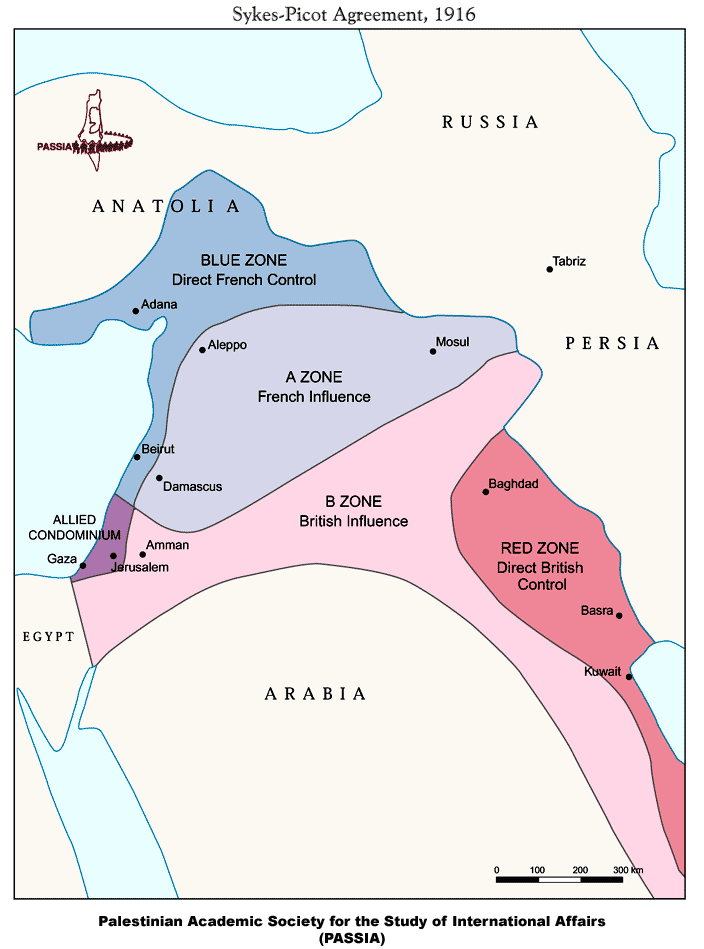
The Balfour Declaration had been in the background even before the advent of WW1. Britain and Fance (and to a lesser degree the Russians) prepared to divide the spoils of war and the Ottoman Empire should they defeat it, and two diplomats were in deep negotiations to finalise an agreement which became known as the Sykes-Picot Agreement of 1916. This was a secret agreement negotiated by two officials from Britain and France: Sir Mark Sykes (1879-1919) and Francois Georges-Picot (1870-1951). They effectively divided the Ottoman Empire into two sphere of influence (see map below) while Palestine and Jerusalem were to be governed by an international administration. Britain was allowed access to the Mediterranean via the ports of Haifa and Akka.
The war with the Turks ended in victory for the Allies 3 years later, on the 28th June 1919. Article 22 of the Covenant of The League of Nations signed at this time, prescribed that the wishes of the people formerly belonging to the Ottoman Empire be a principal consideration in the selection of the Mandatory. It is worth mentioning that Article 22 ascribed a top Category A Mandate for Palestine as one of the "communities formerly belonging to the Turkish Empire [and which] have reached a stage of development where their existence as independent nations can be provisionally recognised...until such time as they are able to stand alone".
Colonial minds do enjoy, albeit to a miniscule degree, a sense of what may be fair for their colonial subjects. No lesser zionist sympathiser than Mark Sykes did volunteer in 1918 that if Arab nationality is to be recognised in the conquered Middle East, then surely some form of national administrative control can be allowed in Palestine. Another pro-zionist leader, Winston Churchill declared later in 1922 that the whole idea of a Jewish homeland in Palestine stood in conflict with British policy of taking into account the wishes of the people in mandated territories resulting in representative institutions as soon as they are ready for self-government.
According to the surveys conducted at the time, it was not Britain that the Arabs had opted for to run the Palestine Mandate. They had opted for the United States to be their supervisory body. The Zionist leadership opted for the trusteeship of Great Britain over Palestine and when Turkish rule formally ended under the Treaty of Sevres on 10 August 1920, the Zionists ensured that the famous Balfour Declaration was embodied in it under Article 22. Yet, it is worth remembering that the British Mandate over Palestine was ratified in July 1922 by the League of Nations, but did not come into effect until September 1923. But it could not become operational until peace with Turkey was signed and sealed in August 1924. So legally speaking, Palestine from 1917 (when the Balfour Declaration was issued) until 1924 (when the peace Treaty was ratified with Turkey - a total of 7 years) was 'occupied territory'. This means that Britain remained bound by the restrictions of the Hague Convention of 1907 outlining the laws of war and war crimes. Where are the legal brains today to stand by this?
It is also worth noting that the moderate minds within the British government who were set against the establishment of a Jewish home in Palestine, has nearly four and a half years (from the date the Balfour Declaration was issued to the ratification of the Mandate by the League of Nations) to harness all their political muscle to stop its implementation. But this was never to be.
The embodiment of this Zionist dream within the League’s Covenant sealed the fate of Palestine at this early stage of the Mandate. If there was any doubt in anyone’s mind about this linkage, it was dispelled by Article 4 of the Mandate which stated:
“An appropriate Jewish Agency shall be recognised as a public body for the purpose of advising and cooperating with the Administration of Palestine…as may affect the establishment of the Jewish national home and the interests of the Jewish population in Palestine…The Zionist Organization shall be recognized as such agency…and shall take steps in consultation with His Britannic Majesty’s Government to…assist in the establishment of the Jewish national home in Palestine”.
Winston Churchill (1874-1965) twice British Prime Minister between 1940-45 and 1951-55, endorsed it officially in a letter he wrote in 1920 which said that “it has fallen to the British Government, as a result of the conquest of Palestine, to have the opportunity and the responsibility of securing for the Jewish race all over the world a home and a centre of national life. The fiery energies of Dr Weizmann leader of the Zionist project, supported by the full authority of Lord Allenby, are all directed to achieving the success of this inspiring movement. Of course Palestine is far too small to accommodate more than a fraction of the Jewish race, but if there should be created in our lifetime by the Banks of the Jordan a Jewish State under the protection of the British Crown, which might comprise 3 or 4 million Jews, an event would have occurred in the history of the world which would be especially in harmony with the truest interests of the British Empire”.
In this atmosphere of promises and deceptions, the Mandate for Palestine was formally allotted to Great Britain at the Peace Conference of San Remo on 25 April 1920. The borders of Mandate Palestine were drawn at this conference.
Speaking of deceipts and decpetions, we urge the reader to examine Chapter 9 in George Antonius' "The Arab Awakening" a seminal book on the history of the Arab world. Antonius (1891-1941) outlines for the first time all the correspondence between Sir Henry McMahon and Sherif Hussein. The conclusion reached is that the British government double-crossed the Palestinian leadership and renaged on its promises.
The Palestinian population grew suspicious of the intentions behind the Balfour Declaration and the ambiguity embedded within its text. They energetically lobbied the British authorities to stand by the promises made to them for eventual independence once the British Mandate had ended and were genuinely frustrated by the lack of committment to those promises. These frustrations came to the boil on the Muslim holiday of Nebi Musa in Jerusalem on 4 April 1920 and lasted for 4 bloody days. The British Military Command appointed a commission, known as the Palin Commission (after its head Major-General Sir Philip Palin) to investigate.

This disturbance was to be the first of many riots by the Palestinians and this Commission the first of many commissions by the British Mandate. The riots were suppressed and the commision reports were disregarded. The Zionists had a project of their own to take over historic Palestine and the seeds to facilitate that path for them were planted by no lesser a personality than Sir Herbert Samuel.
Herbert Samuel, the first British High Commissioner in Palestine (served 1920-1925) was known to be an arch-Zionist and the one person who is credited with preparing the ground in Palestine for the implementation of the Balfour Declaration to enable the "Jewish Homeland" in Palestine to turn into the Jewish state in 1948. Being of the Jewish faith, many believed that Samuel's appointment would give a signal as to his alignment with Zionist ideal and objectives. He himself stated at the time that..."it would be inadvisable for any Jew to be the first Governor". Thanks to the persistent prodding by Chaim Weizmann, Samuel, his close friend, was encouraged to accept the post.
At that time many of the high establishment figures in British politics including the military administrators in Palestine and Egypt were against the Balfour Declaration and its vague wording. They knew that trouble will come if the parameters of the Mandate were not revised. In the short period leading to the transfer to civilian administration in 1920, Major General Sir Louis Bols, the military administrator at the time, in handing the reigns to Samuel, is known to have told him that he wanted him "to sign a receipt', to which Samuel responded: "for what?" and Bols responded: "For Palestine". According to Samuel's memoirs, on the day of the transfer of administration in Jerusalem, Bols handed a well typed document with names and dates which Samuel signed. It said: "One Palestine Complete".

Herbert Samuel (1870-1963)
The embodiment of the Balfour Declaration withing the League's Covenant was seen by many as a turning point in Western-Arab relations. Not only did it contradict the meaning of Article 22 of the Mandate for Palestine, but it also negated promises made earlier to the Arabs for a national homeland in exchange for their help in defeating the Ottoman Empire. Here is what Item 10 of that Agreement stated:
"10. The British and French Governments, as the protectors of the Arab State, shall agree that they will not themselves acquire and will not consent to a third Power acquiring territorial possessions in the Arabian Peninsula, nor consent to a third Power installing a naval base on the east coast or in the Red Sea..."
All the promises made to the Arabs for independence and sovereignty once the war was over, have been broken. To add insult to injury, their land was cut up and Palestine was promised to the the Jews 18 months later via the Balfour Declaration.
Sir John Shaw, Britain's former Chief Secretary of Palestine, who spent nearly 10 years of his life there, stated in a TV interview that the Mandate was "not only immoral but ill-advised". When asked why, he replied: "...because it is not your business, or my business, or British business, or [for] anybody else to interfere in other people's countries and tell them how to run it well. They must be left to their own salvation".

Sir Mark Sykes (1879-1919)

Francois George-Picot (1870-1951)
Worth noting is the fact that the Sykes-Picot Agreement of 1916 had contradicted all promises made in the form of letters exchanged between Sir Henry MacMahon, the Briitish High Commissioner in Egypt and the Sherif of Mecca Hussein bin Ali and dated 14 July 1915-30 January 1916. These became famously known as the MacMahon-Hussein Letters.
This would partly explain why the Sykes-Picot Agreement was never made public until a year later after the Russian Revolution of 1917 when Pravda exposed it in its first major scoop of the decade. Soon afterwards, the Balfour Declaration added another promise and another spanner in the works.
The British, as the Mandatory power in Palestine, therefore, were confronting the contradictions of three irreconcilable aims: promising the Sherif of Mecca a kingdom of his own, assisting Palestine to advance towards (and to achieve) independence under the Mandate Charter, and, finally, the commitment, under the Balfour Declaration, to a future Jewish Home in Palestine.
It is a fact that Sir Mark Sykes himself began to have misgivings about the practical and even the moral validity of the Sykes-Picot Agreement. In a letter he wrote in October 1918 to Lord Robert Cecil, one of the architects ofThe League of Nations and who was awarded the Nobel Peace Prize in 1937, Sykes urged that, for the sake of world interests, Britain, should use its diplomatic power to "to foster and revive Arab civilisation and to promote Arab unity with a view to preparing them [The Arabs] for ultimate independence".
Article 22 of The League of Nations Covenant stated that the right of “those colonies and territories which, as a consequence of the late war, have ceased to be under the sovereignty of the States which formerly governed them and which are inhabited by peoples not yet able to stand by themselves…there should be applied the principle that the well being and development of such people form a sacred trust of civilisation and that the securities for the performance of this trust should be embodied in this Covenant”.
Continued illegal Jewish immigration and the purchase of Palestinian land by the Jewish National Fund reached record levels in the 1930’s with Hitler in Germany, and Mussolini in Italy, advocating the expulsion of Jews from Europe. By the mid 1930’s the Jews in Palestine formed one third of the total population enjoying the blessing of the Balfour Declaration.
Arab resistance escalated from delegations and emmisaries, petitions and declarations to demonstrations and strikes. This culminated in the first Palestine Riots in 1929 forcing the British Government to issue The Passfield White Paper in November 1930 calling for a limitation on Jewish immigration into Palestine. But with Zionist pressure mounting to allow more Jews into Palestine, the registered figures show that such immigration reached ‘invasion’ proportion in just 4 years: from 9,553 Jews in 1932 to 30,327 (1933) to 42,359 (1934) to 61,854 (1935) totalling 144,093. In the same period, the equivalent number of Jewish immigration to the USA was only 14,118. The Palestinian Arabs now braced themselves up for a national revolt.
The Palestinian Arab Rebellion of 1936 lasted for 3 years and forced Britain to send yet again one of its time-honoured commissions to Palestine. Led this time by Lord Peel, it concluded that the two objectives of Article 2 of the Mandate (eventual independence for the indigenous population and the establishment of a Jewish National Home in Palestine) could not be reconciled, The Peel Commission recommended that Palestine be partitioned. The Palestinians, of course, were horrified at this conclusion which granted the Jews 40% of Palestine when Jewish land ownership at the time did not exceed 5.5%; the cruellest provision of all was that there should be, if necessary, a “forcible transfer of Arabs” out of lands allotted to the Jewish state (see later sections).

The Peel Commission (November 1937)
Arab revolt and resistance to this policy was more than equated by fierce British repression against the Palestinians. More than 5,000 were killed and over 15,000 wounded out of a population of 1 million (the equivalent at the time of 200,000 British and 1 million Americans killed and 600,000 British and 3 million Americans wounded). The number of detainees was over 5,600 in 1939 alone. All of this was accompanied by the terrorisation and murder of Arab villagers by special British-trained Jewish squads and underground terrorists.
The Zionist leadership in the persons of Weizmann and Ben-Gurion, were of course jubilant at the Peel recommendations, for this was the first time that the “Jewish National Home” was being officially and publicly equated with a “Jewish State”. It was also being pronounced by a great power, Britain, which was itself the Mandatory.
Ben-Gurion, although grateful for the Peel recommendations, stated soon afterwards that “The Jewish state now being proposed to us is not the Zionist aim. But this will be a decisive step in bringing about the great Zionist aim. In the shortest time possible, it will build the real Jewish strength that will carry us to our historic objectives”.
The Palestine Arab Revolt evoked the sympathy and support of Mahatma Gandhi who wrote in 1938: “Surely, it would be a crime against humanity to reduce the proud Arabs so that Palestine can be restored to the Jews partly or wholly as their National Home”.
As the clouds of WWII were gathering and as the threat of international crisis was looming, the British Government called for a Round Table Conference attended by Arabs, Palestinians and Zionist representatives. Malcolm Macdonald, the new Colonial Secretary was the driving force behind it. The inconclusive conference issued its White Paper on May 17, 1939 which indicated a sudden change of heart from the British Government about the recommendations of the previous Peel Commission. Perhaps this is because the British government began to realise that Palestine could never become the solution for the Jewish problem and that the development of a National Home for the Jews in Palestine can be achieved only as a result of the wholesale eviction of the existing indigenous population. The White Paper of 1939 stated the following:
1. “The proposal of partition recommended by the Royal Commission, namely the establishment of self-supporting independent Arab and Jewish states within Palestine, has been found to be impracticable.
2. His Majesty’s Government now declares unequivocally that it is not part of their policy that Palestine should become a Jewish state.
3. The object of His Majesty’s Government is the establishment within 10 years (i.e., by the end of its Mandate) of an independent Palestine State…in which Arabs and Jews share in government in such a way as to ensure that the essential interests of each community are safeguarded”.
The Zionists rejected the White Paper outright and, with the increasing influence of David Ben-Gurion on Zionist strategic thinking, began to shift their base of political lobbying and influence from London to Washington leading up to 1947. The events taking shape during this period sounded the death knell for Palestine. The Zionist link between Palestine and the Holocaust was forged.